
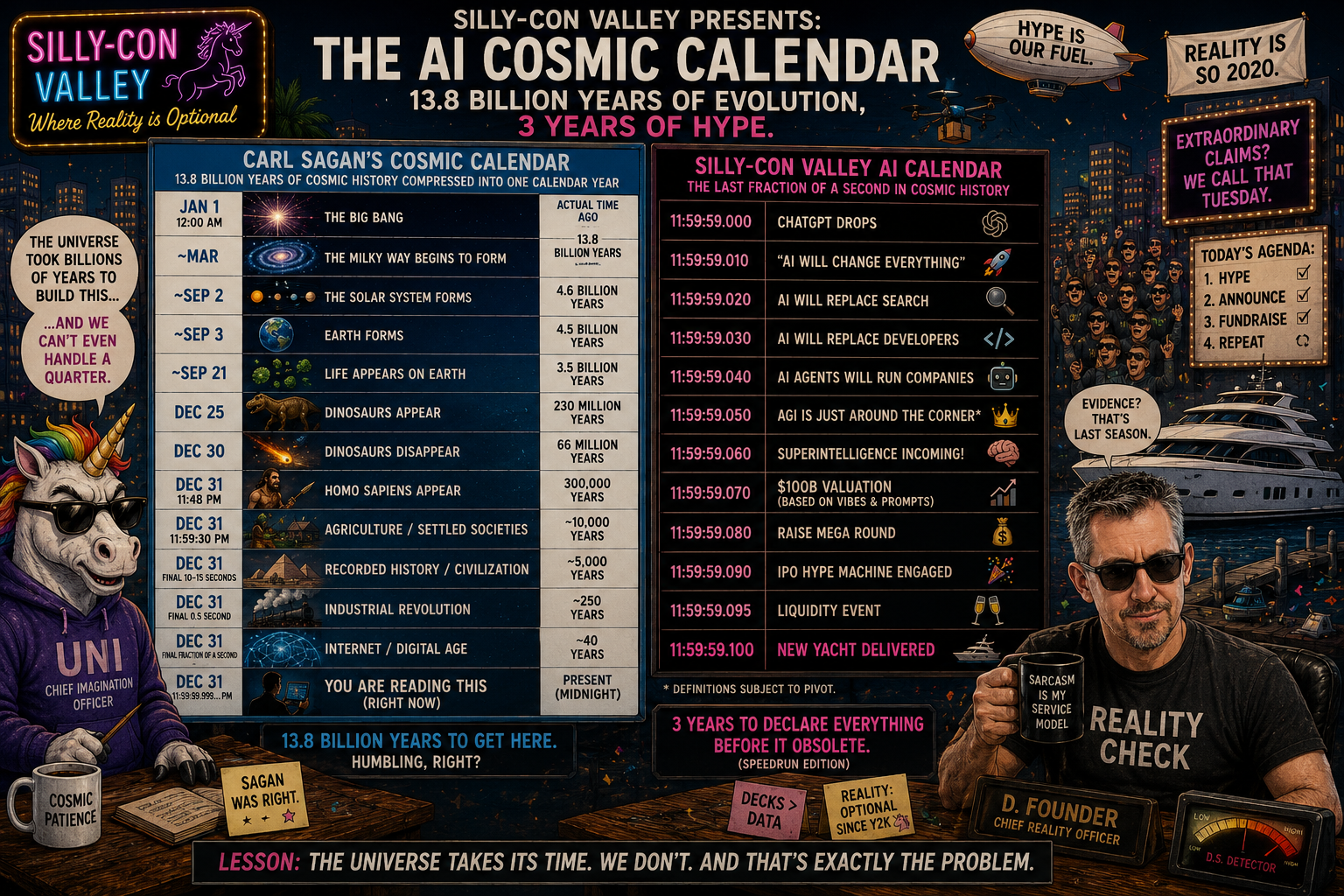
The AI Cosmic Calendar
13.8 Billion Years. Sixteen Minutes to IPO.
Carl Sagan’s Cosmic Calendar compresses the universe’s history into a single year.
In a modern version, the Big Bang happens at midnight on January 1. Our solar system arrives in September. Dinosaurs turn up around Christmas. Our species appears in the final minutes of December 31.
Recorded history gets a few seconds.
The lesson is simple:
We just got here.
Naturally, Silly-con Valley looked at this profound exercise in cosmic humility and thought:
“Cool. But can we 10x it?”
## Welcome to the AI Cosmic Calendar
Imagine compressing the generative AI hype cycle into sixteen minutes:
12:00 AM: ChatGPT arrives.
12:01 AM: “This changes everything.”
12:02 AM: AI will replace search.
12:03 AM: AI will replace programmers.
12:04 AM: AI will replace knowledge workers.
12:05 AM: AI agents will run companies.
12:06 AM: The pitch deck requests a $100 billion valuation.
12:07 AM: “We can see AGI from here.”
12:08 AM: Build more data centers.
12:09 AM: Build power plants for the data centers.
12:10 AM: “Reasoning!”
12:11 AM: “Agents!”
12:12 AM: “Superintelligence!”
12:13 AM: Someone asks whether customers are saving money.
12:14 AM: “You’re thinking too small.”
12:15 AM: IPO.
12:16 AM: Customer question moved to next quarter.
Human intelligence emerged through billions of years of evolution.
Silly-con Valley gave itself sixteen minutes to announce the replacement.
## From “could” to “will” in three slides
AI can already do extraordinary things.
That should make it easier to discuss its capabilities honestly. Somehow, it also provides excellent cover for selling everything it hasn’t done yet.
There is an enormous difference between:
- What a system demonstrably does.
- What it might plausibly do next.
- What somebody raising $10 billion needs you to believe it will eventually do.
A pitch deck can fit all three on the same slide.
A model improves on a benchmark. The presentation advances to the end of human labor.
An agent completes a restaurant booking. Autonomous corporations are apparently six months away.
A coding model builds an application. Someone opens a spreadsheet titled “Engineering Headcount Reduction.”
The demo may be real.
The staffing decision is real too.
Everything connecting them is doing a remarkable amount of work.
Possibility becomes probability.
Probability becomes inevitability.
And inevitability becomes valuation.
That is the most important interval on the AI Cosmic Calendar: the distance between “could” and “will.”
Apparently, it’s about three slides.
## The future is certain. Your job is under review.
A product can improve faster than an organization learns to use it.
A model can produce work faster than someone can check it.
And a company can announce an AI transformation long before it knows which parts of the business will improve.
For the person buying the vision, this is an exciting strategic opportunity.
For the person expected to supervise the output while doing the work of two departed colleagues, it comes with a new responsibility:
Prove the productivity gains already announced at the all-hands.
This is where the future becomes unusually specific.
The technology’s ultimate potential remains open-ended.
Your department’s savings target is due Friday.
## The missing calendar entry
Most grand AI timelines follow a reassuringly tidy sequence:
AI → AGI → superintelligence → singularity.
There is rarely a box in the middle labeled:
“Figure out where this works reliably, who is responsible when it fails, and whether the benefits survive contact with the electricity bill.”
It’s a difficult box to fit on a keynote slide.
“We don’t know yet” doesn’t build much launch momentum.
“It depends” is hard to put on a hoodie.
And “This technology is extraordinary, but its long-term economic impact remains uncertain” leaves an awkward amount of room for due diligence.
So we get a date.
AGI by Tuesday.
If Tuesday becomes inconvenient, there is always a revised definition of AGI.
## A little cosmic humility
Sagan’s calendar gives us perspective. It cannot tell us when—or whether—AGI will arrive.
It can remind us to be careful not to mistake our current moment for the culmination of everything.
Generative AI may become one of humanity’s most consequential technologies. Its potential deserves serious attention.
So do the ordinary questions:
Does it work outside the demo?
For whom?
At what cost?
Who checks the result?
Who bears the risk?
And where is the evidence?
These questions belong in the calendar before the staffing cuts, infrastructure commitments, and declarations that entire professions are obsolete.
The universe took 13.8 billion years to get us here.
Perhaps we can spare a moment to check the claims.
Welcome to Silly-con Valley.
AGI is on the calendar.
Due diligence is on the waitlist.