
Reading list
The Silly-con Valley Reading List is for anyone who wants to understand the serious ideas behind the jokes.
These books explore the systems, incentives, myths, and power structures shaping tech culture, startup logic, AI hype, modern work, social media, and the attention economy.
Consider it the syllabus behind the satire: less “move fast and break things,” more “who benefits, who pays, and why does every solution require another dashboard?”
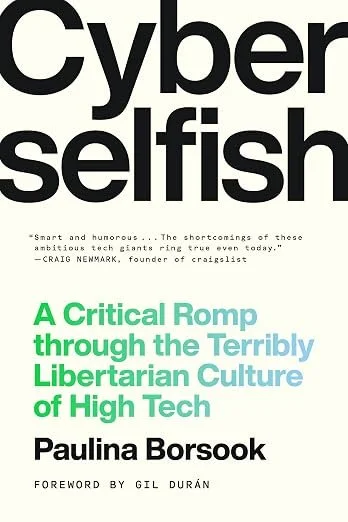
Cyberselfish: A Critical Romp through the Terribly Libertarian Culture of High Tech by Paulina Borsook
Cyberselfish examines the libertarian ideology that took root in Silicon Valley long before Big Tech became big. Originally published in 2000, Borsook explores a culture that celebrated individualism, free markets, deregulation, and technological progress while often dismissing government, social responsibility, and the institutions that made much of the technology industry possible. Her central contradiction is difficult to miss: an industry built partly on decades of publicly funded research developed a worldview deeply suspicious of the public sector that helped create it.
For Silly-con Valley readers, it feels less like a history book than an origin story. Many of the ideas that now appear in debates about billionaire power, regulation, AI, network states, and tech executives redesigning society were already visible decades ago. The technology changed. The valuations added a few zeros. The ideology scaled beautifully. Silicon Valley promised to change the world. Borsook was asking an important question remarkably early: according to whose values?
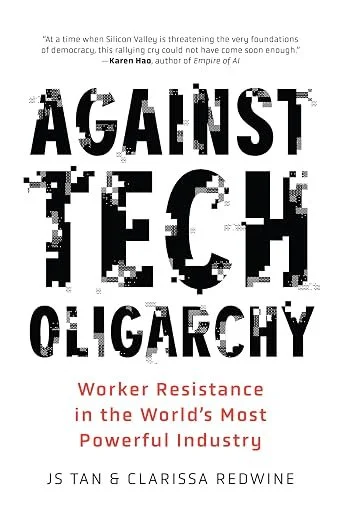
Against Tech Oligarchy: Worker Resistance in the World’s Most Powerful Industry by JS Tan and Clarissa Redwine
Against Tech Oligarchy tells the story of the tech-worker movement and the struggle over who gets a say in what the technology industry builds and how it uses its enormous power. Drawing on the authors’ organizing experience, it follows workers challenging their employers over military contracts, workplace conditions, corporate ethics, and unionization—from protests around Google’s Project Maven to organizing at Kickstarter, the New York Times, and the largely untold union drive at Twitter. The book also examines why that movement lost momentum as layoffs, management resistance, and a changing political culture shifted power back toward executives.
For Silly-con Valley readers, it asks a question conveniently missing from most conversations about the future of technology: what about the people actually building it? Silicon Valley loves telling us that a handful of visionary founders are changing the world. Tan and Redwine tell the story from the other side of the org chart—the engineers, designers, product managers, and other workers who discovered that building the future doesn’t necessarily give you a vote in deciding what that future should be. Perhaps the most disruptive technology Silicon Valley workers ever discovered wasn’t AI, crypto, or the blockchain. It was collective action.
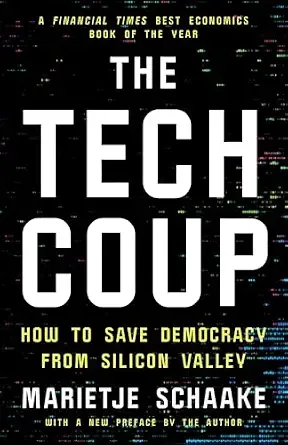
The Tech Coup: How to Save Democracy from Silicon Valley by Marietje Schaake
The Tech Coup: How to Save Democracy from Silicon Valley examines how technology companies have accumulated powers that were once largely associated with governments and public institutions. Marietje Schaake traces how Silicon Valley moved from building useful products and online platforms to controlling critical infrastructure, communications, information flows, surveillance capabilities, and increasingly artificial intelligence. Drawing on her experience in European politics and technology policy, Schaake argues that governments have repeatedly failed to keep pace, allowing private companies to make decisions with enormous public consequences while operating with far less transparency and accountability than democratic institutions. The problem is not simply that Big Tech has become wealthy or influential. It is that companies whose executives were never elected increasingly shape speech, privacy, security, access to information, and the technological infrastructure on which governments themselves depend. Schaake’s argument is ultimately about sovereignty: democratic societies outsourced more and more power to technology companies, often without fully realizing what they were giving away.
For Silly-con Valley readers, it is the story of what happens when “move fast and break things” meets institutions that move slowly and apparently forgot they were allowed to make rules. Silicon Valley spent decades insisting that government was too old, slow, bureaucratic, and technologically clueless to understand the future. Then governments became dependent on the companies making that argument. The result is a strange arrangement where corporations build the infrastructure, write the algorithms, collect the data, moderate the public square, develop the AI, and then explain to elected officials why regulating any of it might hurt innovation. The pitch was that technology would democratize everything. Schaake asks the less comfortable question: what happens when the companies doing the democratizing become powerful enough to outrun democracy itself? Silicon Valley promised to disrupt every industry. The Tech Coup explores what happens when democracy turns out to be on the disruption list.
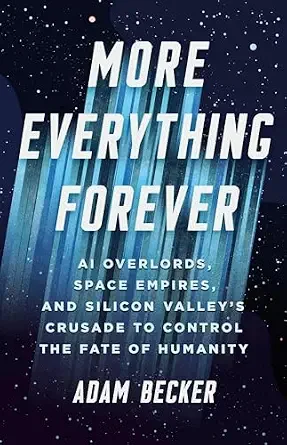
More Everything Forever: AI Overlords, Space Empires, and Silicon Valley's Crusade to Control the Fate of Humanity by Adam Becker
More Everything Forever examines the sprawling ideology behind Silicon Valley’s most ambitious promises: artificial superintelligence, colonizing Mars, defeating death, uploading minds, and expanding humanity across the universe. Adam Becker traces these ideas through movements including transhumanism, effective altruism, longtermism, and the belief that sufficiently advanced technology can—and should—determine humanity’s future. He looks at figures and institutions that have helped move these ideas from internet philosophy and science fiction into startups, research labs, philanthropy, and enormous pools of capital. Becker’s argument is that beneath the different acronyms and moonshots sits a remarkably consistent worldview: technological progress is inevitable, more intelligence and expansion are inherently good, and the people building the future today deserve an extraordinary amount of influence over what humanity becomes tomorrow.
For Silly-con Valley readers, it is a tour of what happens when “think big” stops being startup advice and becomes a philosophy of civilization. The same industry that struggles to make Bluetooth connect reliably is now debating how to govern superintelligence, populate the galaxy, resurrect humanity digitally, and optimize the next trillion years. The pitch is abundance, immortality, intelligence, exploration, and a future with essentially no ceiling. Becker’s critique asks a more inconvenient question: who decided these were humanity’s priorities in the first place? Silicon Valley spent decades insisting there should be no limits on what technology can achieve. More Everything Forever explores what happens when that becomes no limits on who gets to decide our future.
The Nerd Reich: Silicon Valley Fascism and the War on Democracy by Gil Durán
The Nerd Reich examines how a faction of Silicon Valley’s wealthiest and most influential figures moved from libertarian distrust of government toward something far more radical: the belief that democracy itself is an obstacle to technological and economic power. Gil Durán traces that evolution through thinkers and figures including Peter Thiel, Marc Andreessen, Balaji Srinivasan, Curtis Yarvin, and Elon Musk, connecting ideas from The Sovereign Individual, network states, crypto, AI, and corporate governance to a broader vision of society run less like a democracy and more like a company. His argument is that tech’s authoritarian turn did not appear overnight; it grew out of decades of ideology, capital, political influence, and a conviction among some elites that the smartest people should simply be allowed to run things.
For Silly-con Valley readers, it is a case study in what happens when founder mythology escapes the startup ecosystem and becomes a theory of government. The same culture that celebrates benevolent dictators, worships scale, treats regulation as technical debt, and assumes every institution can be “disrupted” eventually starts asking why elections need to exist at all. The pitch is efficiency, freedom, innovation, and progress. The underlying product roadmap looks a lot like privatized power with fewer pesky stakeholders. Silicon Valley spent decades trying to make government run more like a startup. Durán warns that some people finally decided it would be easier to replace the government with one.
Chokepoint Capitalism: How Big Tech and Big Content Captured Creative Labor Markets and How We'll Win Them Back by Rebecca Giblin and Cory Doctorow
Chokepoint Capitalism explains how Big Tech and Big Content have positioned themselves between creators and audiences, turning creative markets into toll roads. The book shows how platforms, publishers, streamers, labels, and other intermediaries use scale, contracts, data, and market power to squeeze writers, musicians, filmmakers, artists, and journalists while presenting themselves as champions of creativity.
For Silly-con Valley readers, it is a sharp look at how “democratizing access” often becomes “owning the pipe,” and why the creator economy keeps producing more creators, more content, and fewer people who can actually make a living.
The Age of Extraction: How Tech Platforms Conquered the Economy and Threaten Our Future Prosperity by Tim Wu
The Age of Extraction examines how dominant tech platforms moved from promising openness, convenience, and shared prosperity to building systems that extract value from users, workers, sellers, creators, and whole markets. Wu argues that platform power is not just a tech problem, but an economic and political one: the companies that mediate modern life can set the terms, harvest the data, control access, and turn dependence into profit.
For Silly-con Valley readers, it is a serious map of the machinery behind the joke: the app says it is empowering you, the marketplace says it is creating opportunity, the platform says it is connecting the world, and somehow everyone ends up paying rent to the interface.
The Attention Merchants: The Epic Scramble to Get Inside Our Heads by Tim Wu
The Attention Merchants traces the history of industries built around capturing and reselling human attention, from early advertising to television, social media, and the modern internet. Wu shows how attention became a commodity, how platforms learned to monetize distraction, and why the fight for our focus has reshaped media, politics, work, and daily life.
For Silly-con Valley readers, it is a foundational text for understanding the business model behind the infinite scroll: when the product is free, the invoice arrives as anxiety, outrage, addiction, and a brain that can no longer read the terms of service.
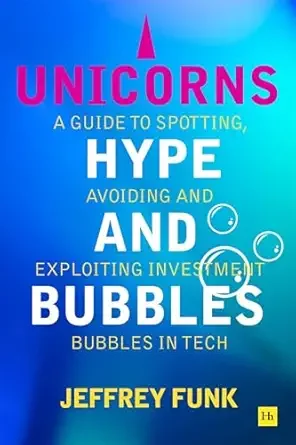
Unicorns, Hype, and Bubbles: A guide to spotting, avoiding, and exploiting investment bubbles in tech by Jeffrey Funk
Unicorns, Hype, and Bubbles examines how tech investment manias form, why investors and media keep mistaking hype for value, and how inflated promises turn into billion-dollar illusions. Funk looks at the patterns behind overvalued startups, speculative narratives, and “disruptive” companies whose business models often fail to match their valuations.
For Silly-con Valley readers, it is a useful guide to the machinery behind founder mythology: how buzzwords become markets, markets become bubbles, and bubbles become someone else’s exit strategy.

Technological Revolutions and Financial Capital: The Dynamics of Bubbles and Golden Ages by Carlota Perez
Technological Revolutions and Financial Capital explains why major technological revolutions so often travel with financial bubbles. New technologies attract capital, capital attracts speculation, speculation attracts mythology, and before long everyone is explaining why this particular mania is not a mania because the TAM is simply too large to obey gravity. Perez’s key point is that bubbles are not just irrational noise. They can be wasteful, destructive, and ridiculous, but they can also build the infrastructure, habits, networks, and institutions that make a later “golden age” possible.
For Silly-con Valley readers, this is basically the origin story of every pitch deck that mistakes a funding cycle for a civilizational turning point. The book helps explain why tech hype is not a bug in the system; it is often part of the system’s operating model. Read it to understand how the future gets financed, inflated, crashed, and eventually repackaged as a keynote about resilience.

Enshittification: Why Everything Suddenly Got Worse and What to Do About It by Cory Doctorow
Enshittification turns a viral complaint about the internet getting worse into a serious theory of platform decay. Doctorow argues that digital services often begin by serving users, then shift toward pleasing advertisers, sellers, investors, or business partners, and eventually squeeze everyone once they are locked in. The book connects bad feeds, worse search results, trapped customers, surveillance, monopolies, and degraded user experience to specific business incentives and policy choices, not some unavoidable law of technology.
For Silly-con Valley readers, it is essential vocabulary for understanding how “growth” becomes extraction, how platforms turn convenience into captivity, and why the app that once made your life easier now feels like a landlord with push notifications.
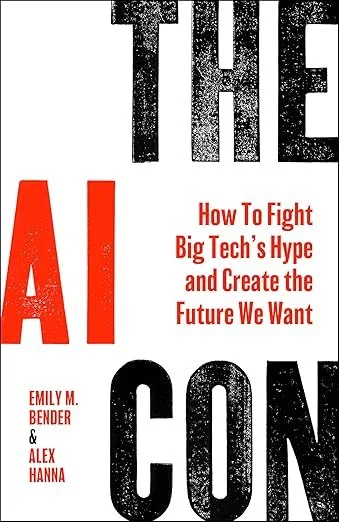
The AI Con: How to Fight Big Tech’s Hype and Create the Future We Want by Emily M. Bender and Alex Hanna
The AI Con challenges the grand promises, magical language, and inevitability narratives surrounding artificial intelligence. The authors argue that much of today’s AI hype serves Big Tech’s interests by distracting from labor exploitation, environmental costs, biased systems, surveillance, and concentrated power.
For Silly-con Valley readers, it is a grounded antidote to “the model will solve everything” thinking: a reminder that AI is not magic, the future is not inevitable, and every supposedly intelligent system still comes with owners, incentives, trade-offs, and people cleaning up the mess.
Empire of AI: Dreams and Nightmares in Sam Altman's OpenAI by Karen Hao
Empire of AI examines how OpenAI went from a nonprofit founded to protect humanity from runaway artificial intelligence to the company most responsible for accelerating the AI arms race. Hao traces the transformation through Sam Altman’s rise, Microsoft’s influence, ChatGPT’s explosive launch, boardroom warfare, safety debates, and the uncomfortable gap between OpenAI’s public mission and private incentives.
For Silly-con Valley readers, it is a sharp case study in how tech empires are built: start with a world-saving mission, add unlimited capital, wrap everything in safety language, and quietly depend on scraped data, invisible labor, massive infrastructure, and increasingly closed decision-making. The dream is artificial intelligence for everyone. The nightmare is discovering who gets to own it.

Filterworld: How Algorithms Flattened Culture by Kyle Chayka
Filterworld explores how recommendation algorithms have reshaped culture by nudging music, food, travel, design, art, and personal taste toward the same optimized sameness. Chayka argues that platforms do not just help us discover culture; they increasingly decide what becomes visible, desirable, and profitable, flattening local flavor and personal curiosity into content that performs well in the feed.
For Silly-con Valley readers, it is a sharp look at how “personalization” often becomes cultural autocorrect: everything tailored to you, yet somehow everything starts to look, sound, and feel the same.