
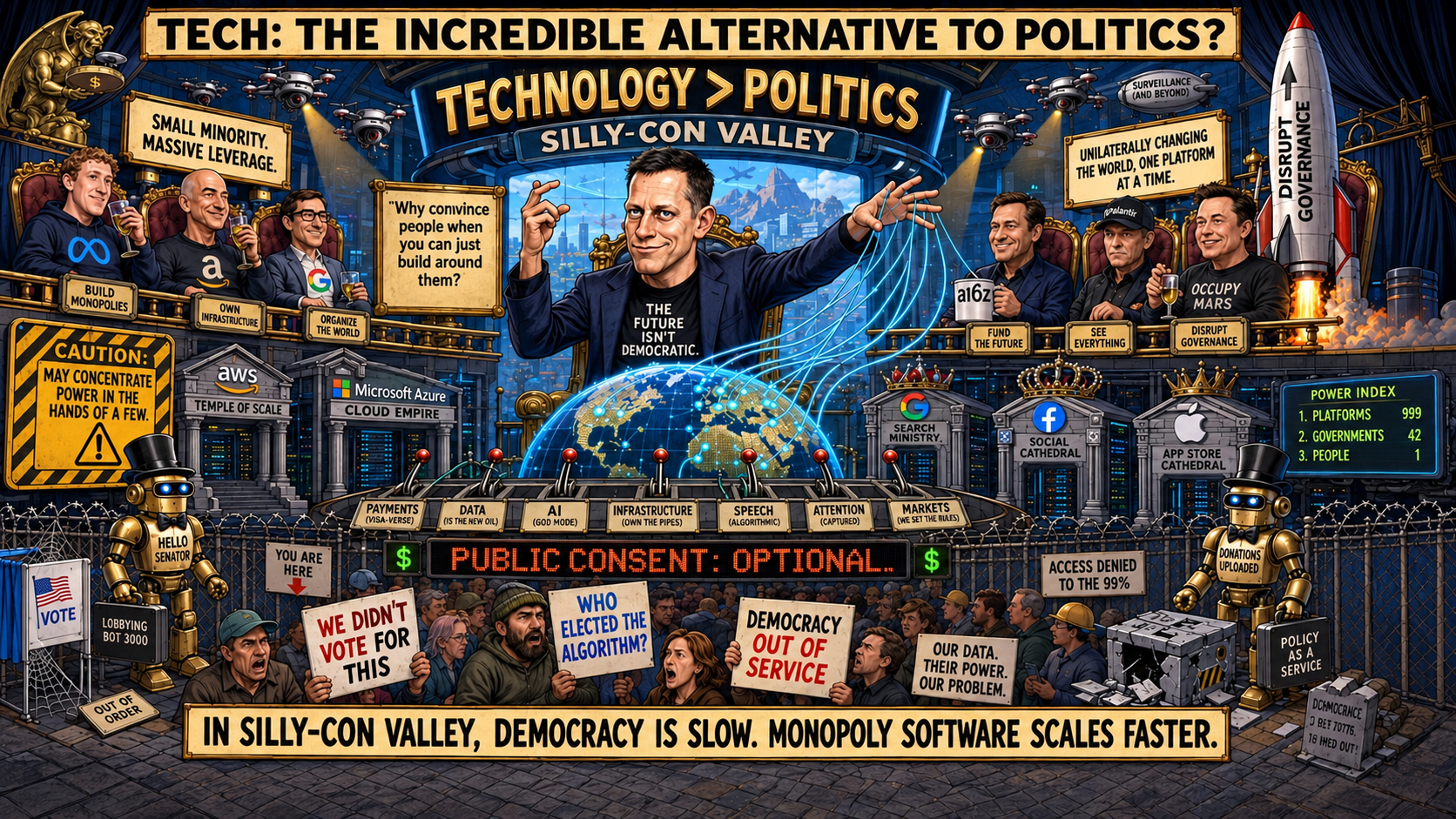
Why Win an Election When You Can Own the Platform?
With the introductions out of the way, it’s time to turn up the temperature.
Our first few posts introduced Silly-con Valley and its two main characters, D. Founder and Uni. We’ll get deeper into their history—and how they ended up wandering through the Valley—in future posts.
But first, there’s something you should know about Silly-con Valley.
It has been years in the making.
During that time, we’ve collected more than 500 ideas for cartoons, posts, products, headlines, and assorted technological absurdities.
The remarkable thing is how little imagination this has required.
The Valley keeps writing the material for us.
Every funding announcement that mistakes capital for validation. Every founder promising to “change humanity.” Every product designed to solve a problem created by the previous product. Every executive explaining why replacing thousands of people with AI is actually about “empowering employees.”
Hubris. Self-aggrandizement. Mythological egos. World-changing ambitions attached to increasingly questionable definitions of “better.”
Honestly, keeping up has been the hard part.
So when it came time to write our first real Silly-con Valley essay, D. Founder and Uni faced a problem:
Out of 500-plus ideas, where the hell do you start?
Then a book landed on our radar.
The Nerd Reich: Silicon Valley Fascism and the War on Democracy, by journalist Gil Durán.
Durán makes a deliberately provocative argument about the political ideas circulating among some influential figures in Silicon Valley and their relationship with democracy, government, and technological power.
Whatever you make of the book’s larger argument, we didn’t get very far before encountering a quote that stopped us cold.
“The initial founding vision was that we were going to use technology to change the whole world and basically overturn the monetary system of the world… the basic idea was that we could never win an election on getting certain things because we were in such a small minority… But maybe you could actually unilaterally change the world—without having to constantly convince people and beg people and plead with people who were never going to agree with you—through technological means… technology is this incredible alternative to politics.” Peter Thiel, 2010
It was Peter Thiel, speaking in 2010 about the founding vision behind PayPal and the possibility of using technology to accomplish things that could not necessarily be achieved through conventional politics.
The key idea was startlingly simple:
Technology could be an alternative to politics.
Thiel’s remarks were not an isolated formulation. A year earlier, in an essay titled The Education of a Libertarian, he wrote that he no longer believed freedom and democracy were compatible and argued that the challenge was to find ways to “escape” politics rather than depend on it.
Then, at the 2010 Libertopia conference, he made the idea considerably more concrete: if a small minority could not persuade enough people to get what it wanted politically, perhaps technology offered another route.
Change the system itself.
That idea hit us like a product requirement for the past 25 years of tech.
Not because Thiel somehow explained everything wrong with Silicon Valley.
He didn’t.
But because he put unusually explicit words around an instinct we had been circling for years:
Why persuade society when you can redesign the world around it?
Politics Has Terrible Product-Market Fit
Politics is painfully inefficient.
You have to persuade people.
Build coalitions.
Accept compromise.
Answer critics.
Lose sometimes.
There are hearings. Elections. Regulators. Courts. Journalists. Citizens. Unions. Advocacy groups. Local governments. Federal governments.
Worst of all, people disagree with you.
From a founder’s perspective, the whole thing must look horribly designed.
Technology offers a much cleaner operating model.
Build first.
Scale fast.
Become indispensable.
Ask for permission, never.
Then let everyone else debate what just happened.
That isn’t a description of every technology company or every founder. Plenty of technology improves lives without harboring a secret plan to overthrow civilization.
But the operating model is familiar enough.
Uber didn’t begin by asking cities around the world to redesign taxi regulation.
Airbnb didn’t wait for every municipality to reconsider hotel and short-term-rental rules.
Social media didn’t wait for society to determine how platforms reaching billions of people should handle privacy, political speech, misinformation, addictive design, or algorithmic amplification.
Crypto certainly didn’t wait for everyone to finish discussing the future of money.
And generative AI has not exactly been sitting patiently in the lobby while education systems, artists, publishers, workers, courts, governments, and the rest of civilization work out the details.
The product ships.
Adoption grows.
Capital arrives.
Behavior changes.
And eventually someone asks:
Wait. Are we allowed to do this?
By which point the company has 300 million users and a public-policy department.
Permissionless Innovation, Meet Permissionless Society
There is a reason the Valley loves the idea of “permissionless innovation.”
At its best, the concept is genuinely powerful. You don’t want every programmer with a good idea waiting three years for the Department of Websites to approve a prototype.
Experimentation matters.
Entrepreneurship matters.
New technologies often challenge old assumptions for good reasons.
The problem begins when the thing being “disrupted” is no longer just an inefficient business.
Sometimes it’s labor law.
Sometimes it’s privacy.
Sometimes it’s journalism.
Sometimes it’s housing.
Sometimes it’s education.
Sometimes it’s money.
Sometimes it’s the information environment through which millions of people understand reality.
At that point, “move fast and break things” gets a little more complicated.
Because sometimes what gets broken is society.
Yet the startup operating system remains remarkably consistent:
Build.
Launch.
Grow.
Normalize.
Lobby.
And if anyone objects, explain that regulation threatens innovation.
Or, in Silly-con Valley terminology:
We’ll ask forgiveness after the Series Z.
The People Who Keep “Democratizing” Everything
This is where the language gets especially interesting.
Few industries love the word democratize more than technology.
Democratize finance.
Democratize information.
Democratize creativity.
Democratize investing.
Democratize education.
Democratize intelligence.
Apparently democracy is fantastic as long as it’s a product feature.
Because the actual decision-making structure behind many of these systems can look considerably less democratic.
A remarkably small number of founders, executives, investors, engineers, and platform owners can make decisions affecting enormous numbers of people.
Change an algorithm and entire categories of creators lose their audience.
Change an API and businesses disappear.
Change a moderation policy and the boundaries of public conversation move overnight.
Change a pricing model and an ecosystem built around your platform discovers that “partnership” was apparently a monthly subscription.
Train a sufficiently powerful model and suddenly teachers, artists, writers, programmers, lawyers, journalists, regulators, and millions of workers are having a conversation they did not exactly schedule.
The industry says it is building tools.
Then the tools become platforms.
The platforms become infrastructure.
The infrastructure becomes power.
And the people controlling the power continue describing themselves as a software company.
The World Is Not a Sandbox
This may be the deeper problem.
Silicon Valley is exceptionally good at turning questions into engineering problems.
How do we move people around cities?
App.
How do we decide what people should see?
Algorithm.
How do we organize work?
Platform.
How do we determine what information matters?
Ranking system.
How do we fix education?
AI tutor.
How do we fix loneliness?
AI companion.
How do we fix the problems created by all the previous technology?
Excellent news.
We are building more technology.
Engineering problems are attractive because engineering problems have solutions.
Societies are much more annoying.
They have competing values.
Trade-offs.
History.
Power.
Rights.
Externalities.
People who want different things for perfectly legitimate reasons.
You cannot A/B test your way to a universally agreed definition of a good society.
Although someone in Silly-con Valley is almost certainly trying.
And that is why Thiel’s formulation stuck with us.
Not because technology literally replaces politics.
It can’t.
The moment technology changes who has power, who gets paid, who gets heard, who gets watched, who gets hired, who owns what, or who makes the rules, politics comes rushing back in.
You didn’t eliminate politics.
You just embedded it in the product.
And This Is How We Got Silly-con Valley
That realization connected a surprising number of those 500 ideas sitting in our backlog.
Silly-con Valley isn’t really about stupid apps.
It isn’t even about ridiculous founders.
It’s about what happens when an industry becomes enormously powerful while retaining the self-image of a bunch of clever outsiders hacking things in a garage.
The garage now has satellites.
The side project has 3 billion users.
The scrappy startup has a larger market capitalization than many countries’ economies.
The recommendation engine influences culture.
The cloud provider hosts critical infrastructure.
The AI model is being inserted into schools, workplaces, hospitals, governments, militaries, search engines, phones, cars, and probably your refrigerator by the time you finish this paragraph.
Yet the mythology remains:
We’re just builders.
That may be the greatest Silly-con Valley product of all.
The belief that you can change how millions—or billions—of humans live while somehow remaining outside the messy questions of power, politics, accountability, and consent.
You can’t.
Technology does not become less political when it gets powerful enough to bypass politics.
It becomes political infrastructure built by people we never elected, governed by terms of service nobody read, and updated overnight while we were sleeping.
No election required.
No consensus necessary.
Just capital, code, distribution, and enough users who clicked Accept because they wanted to order dinner.
Welcome to Silly-con Valley.
Where reality is optional.
Where the roadmap is fictional but the consequences are real.
Where every social problem is one API call away from being monetized.
Where humans are the edge case.
And where the future is always beta—
but the consequences are GA.