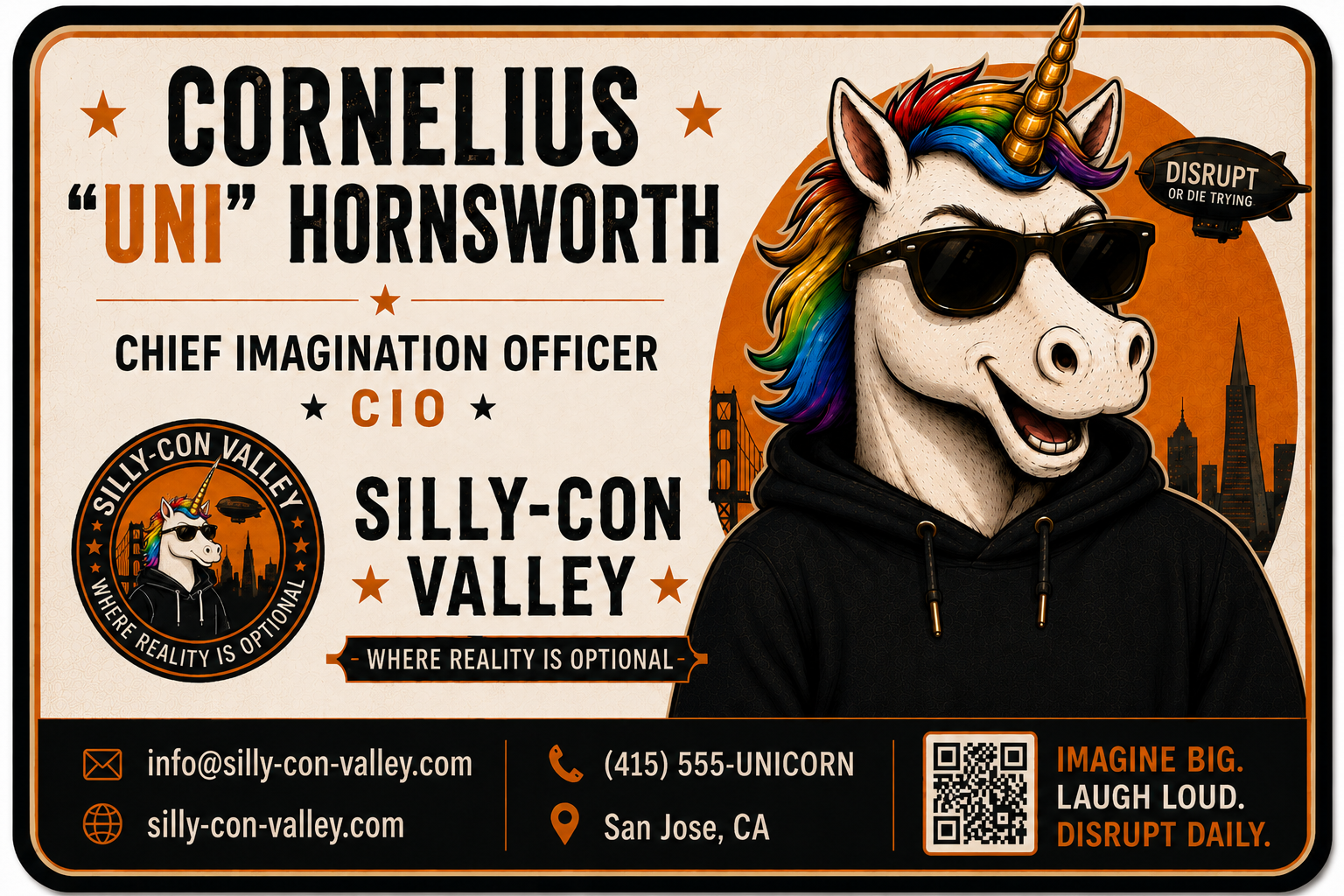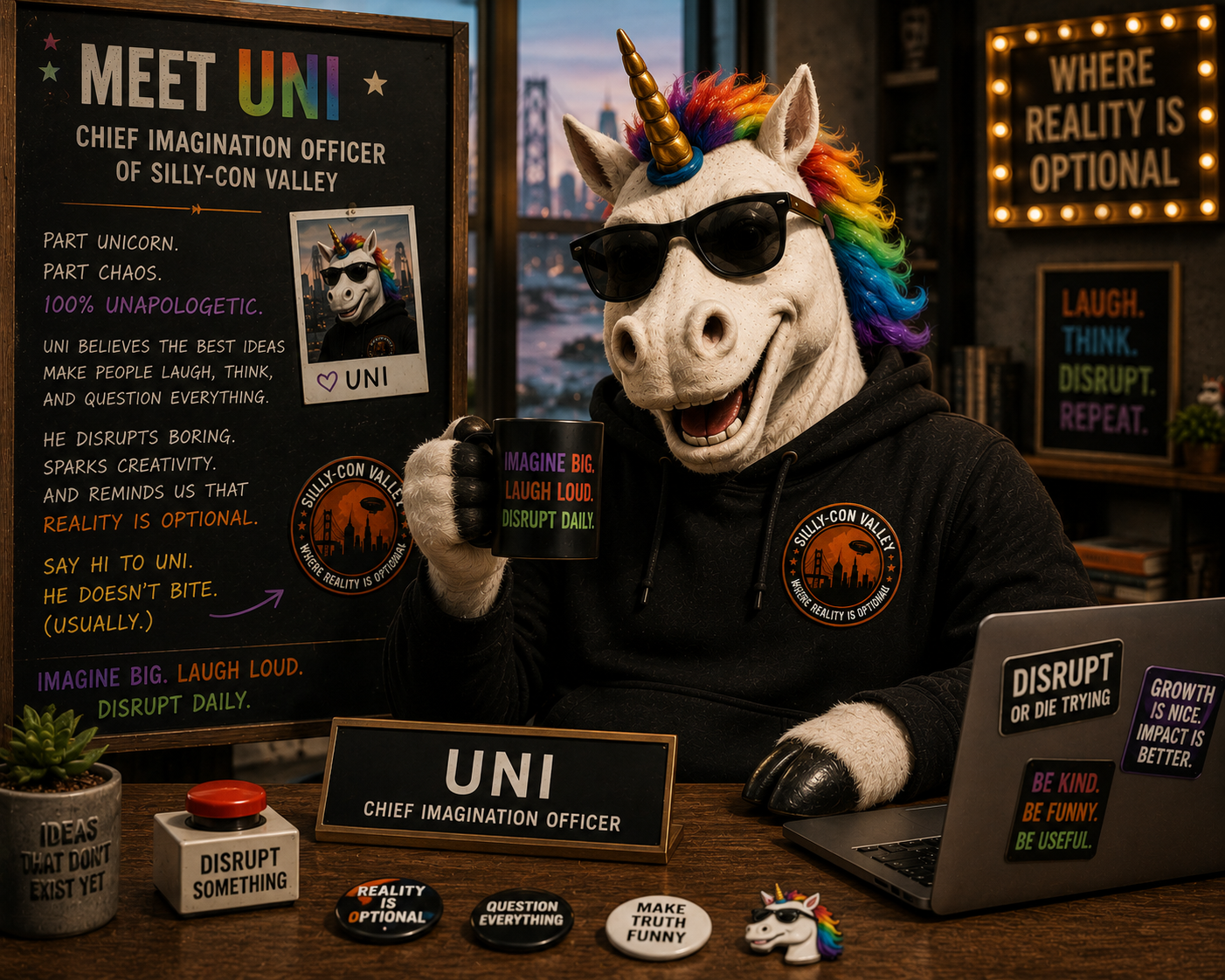
Meet Uni.
Silly-con Valley’s mascot, Chief Imagination Officer, and resident detector of weapons-grade bullshit.
We wanted a unicorn.
Unfortunately, we got one with sunglasses, an attitude, and a suspiciously accurate understanding of hype, vaporware, and hockey-stick-shaped charts.
Silly-con Valley needed a BS detector. So we gave it a unicorn.
Uni is part startup mythology, part product hallucination, and part emotional support creature for anyone who has ever watched a red KPI turn green after someone changed the definition.
Nobody knows exactly where he came from.
Some say he was discovered wandering through an abandoned WeWork after midnight, chewing on a Series A pitch deck.
Others say he was the result of a team that set out to design a horse by committee.
And some believe Uni simply materialized the first time a founder said:
“Profitability is a legacy metric.”
Without irony.
What we do know is that Uni has seen things.
The AI demo that only worked when the engineer was standing nearby.
The “quick pivot” that took three quarters, two reorgs, and a new logo.
The customer research that was ignored because the CEO “had a strong instinct.”
The dashboard measuring growth, engagement, retention, and churn—but somehow never profit.
Uni remembers.
More importantly, Uni notices.
Whenever someone says “disruption” without identifying what actually needs disrupting…
Whenever a vanity metric gets promoted to a business model…
Whenever “AI-powered” appears on something that worked perfectly well last Tuesday…
Whenever a terrible idea acquires a gradient and an upward-pointing arrow…
the sunglasses come down.
That’s the Uni BS Detector.
No algorithm.
No AGI.
No enterprise subscription.
Just one deeply judgmental unicorn asking whether any of this makes sense.
D. Founder brings the questions.
Uni brings the side-eye.
Together, they roam Silly-con Valley asking the things that somehow never make it into the investor update:
Is this a strategy—or hype with a deck?
Are we solving a problem—or monetizing a symptom?
Did we create value—or an anxiety machine with push notifications?
Uni isn’t against big ideas.
He’s against using big ideas as diplomatic immunity from obvious questions.
Because underneath the decks, dashboards, launches, pivots, vision statements, and revolutionary new ways to generate meeting notes, there’s usually a much simpler question:
What are we actually making better for humans?
So when the hype gets too polished, the metrics get too vain, and the word disrupt starts doing unpaid labor, Uni will be there.
Silent.
Judgmental.
Wearing sunglasses indoors.
Because in a Valley where everyone wants to build the next unicorn, someone still has to lower the sunglasses and ask:
“Cool. But should this exist?”