
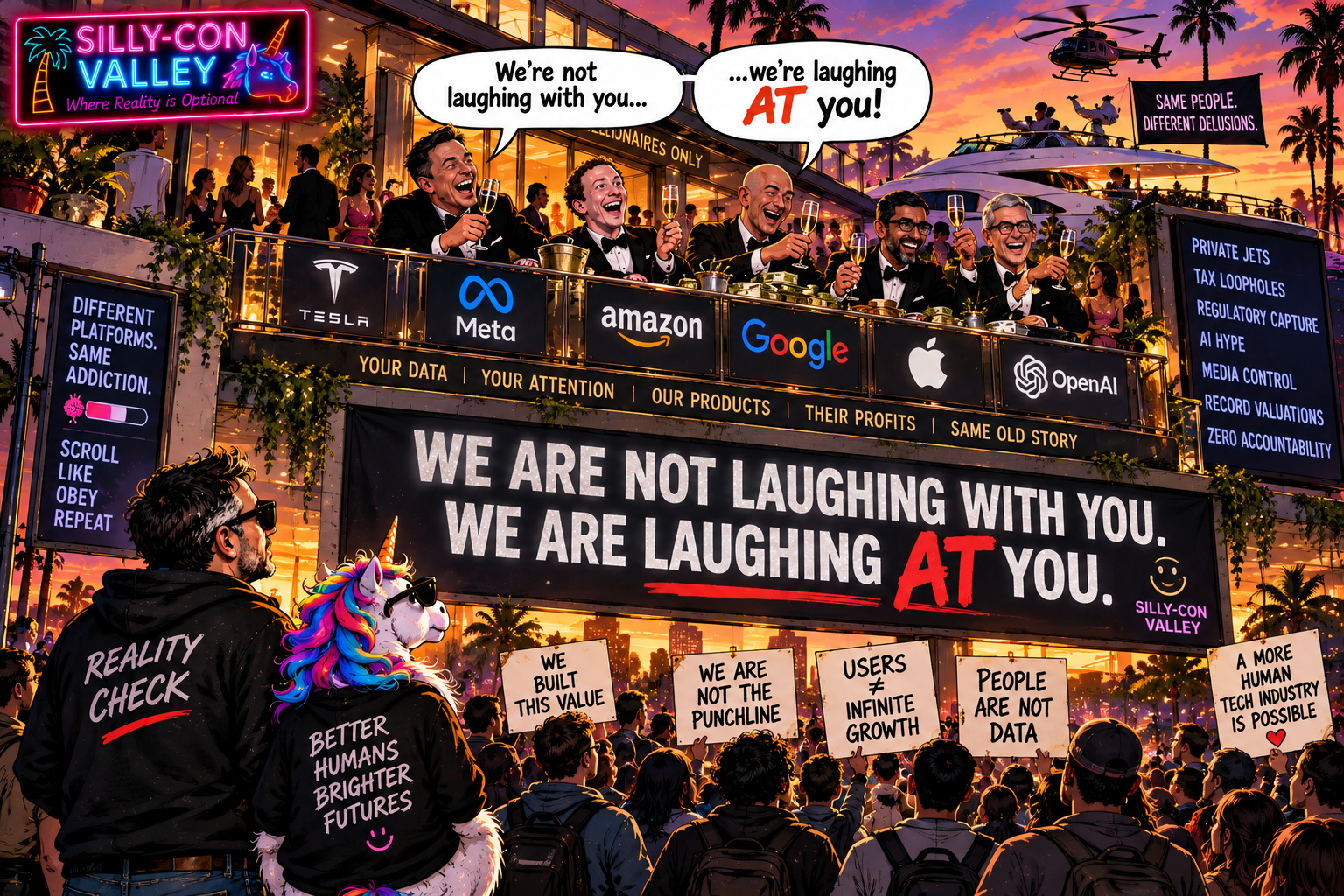
They are laughing at us
In Silly-con Valley, the jokes practically write themselves.
They tell you their products are free. You just have to surrender your personal data, attention, and privacy.
Hilarious.
They promise technology will make your life simpler. Then introduce increasingly complicated solutions to problems you never knew you had.
Comedy gold.
They create addictive experiences, then introduce digital wellbeing features to help you escape the experiences they designed to keep you hooked.
Now that's innovation!
They call you a valued customer, then replace human support with a chatbot that apologizes profusely while accomplishing absolutely nothing.
Thank you for your patience. Your frustration is very important to us.
They tell employees they're family. Until the quarterly earnings report arrives and thousands of family members suddenly become "operational efficiencies."
Nothing personal. Just business.
And perhaps the greatest joke of all?
They promise to change the world for the better while insisting that the world accommodate whatever business model makes them richer.
Cue the standing ovation.
But Who's Actually Laughing?
Here's the thing about humor.
A good joke invites people to laugh together.
A cruel joke needs someone to laugh at.
And when the person telling the joke controls the platform, writes the rules, owns the data, and collects the money, the distinction becomes rather important.
Because what Silly-con Valley calls disruption, the rest of us might experience as inconvenience, exploitation, or another subscription we can't figure out how to cancel.
What it calls innovation, we sometimes experience as adding three steps to something that used to require one.
And what it calls value creation, we might reasonably ask: Value for whom?
That's the question nobody wants to hear from the audience.
Especially when the answer might ruin the business model.
The Business Model of the Punchline
The brilliance of Silly-con Valley's comedy is that the audience doesn't just provide the laughs.
The audience pays for the show.
We fund the companies through our purchases, subscriptions, attention, and data.
We tolerate the broken promises.
We absorb the externalities.
And when the joke goes too far, we're told we simply don't understand innovation.
Or worse, that we're resisting progress.
It's a remarkable arrangement.
The comedians get rich.
The audience gets the bill.
And the critics get labeled Luddites.
Apparently, questioning the business model is now considered an attack on civilization.
It's Not That We Don't Have a Sense of Humor
Here at Silly-con Valley, we love a good joke.
In fact, the absurdities of the technology industry provide us with an almost inexhaustible supply of material.
But there's a difference between laughing at the absurdity of a system and laughing at the people forced to live with its consequences.
We're not against technology. We're not against innovation. And we're certainly not against entrepreneurship.
We're just increasingly curious who all this innovation is actually innovating for.
Because none of it requires treating customers like commodities, employees like disposable assets, or society like an unpaid beta-testing program.
We don't have a problem with technology having a sense of humor.
We have a problem with an industry that increasingly seems to think we're the joke.
And perhaps it's time Silly-con Valley remembered something about comedy:
Eventually, the audience gets to decide whether the joke is funny.
And we're not laughing anymore.
Welcome to Silly-con Valley. Where Reality is Optional.
We're not anti-technology. We're anti-idiocy.