
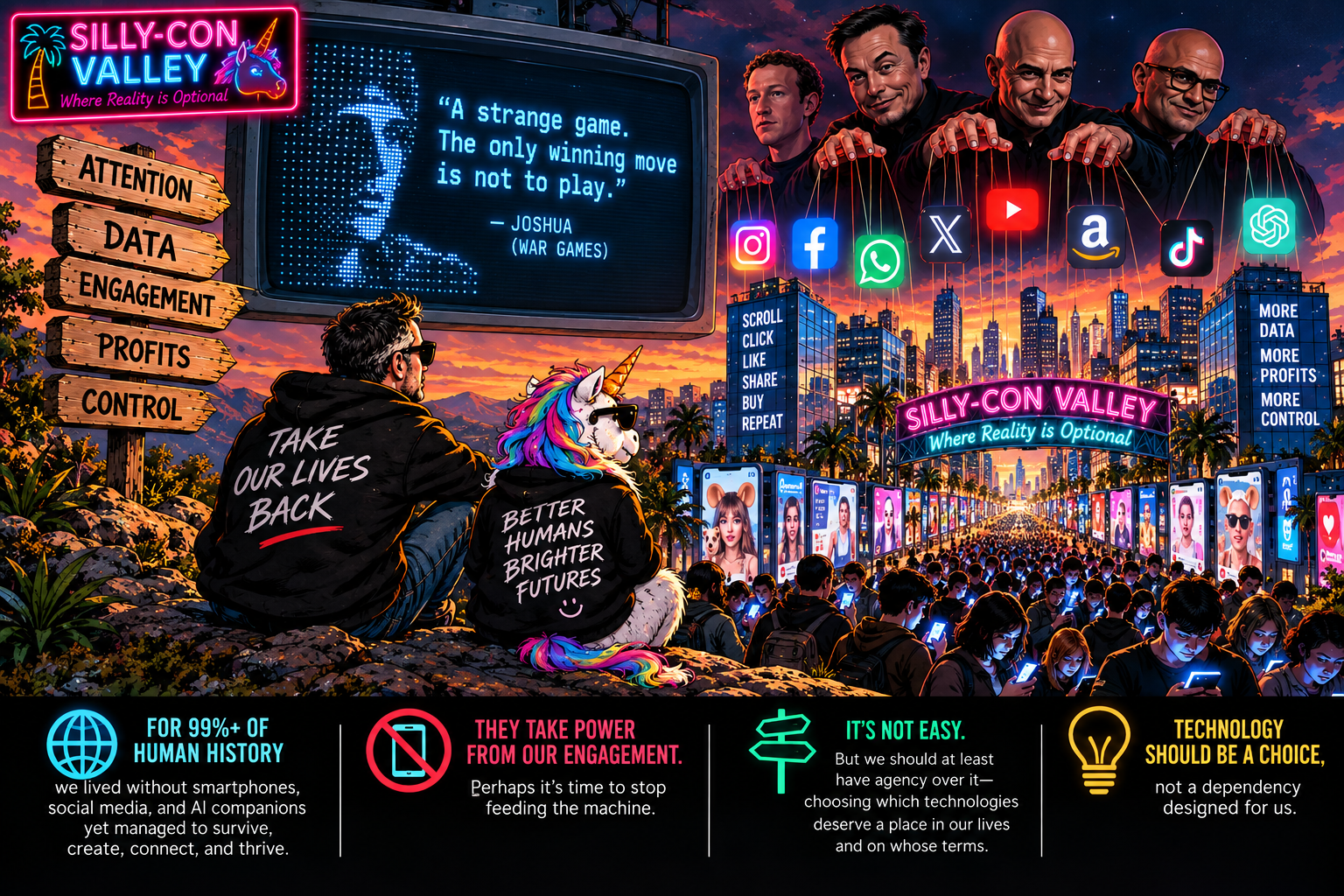
The Only Winning Move Is Not to Play
Maybe the most disruptive thing we can do is stop participating in the game.
In the 1983 movie WarGames, a military supercomputer named Joshua nearly triggers World War III before arriving at a profound realization:
“A strange game. The only winning move is not to play.”
Forty-something years later, that fictional computer may have offered better advice about our relationship with technology than an entire generation of Silicon Valley founders, venture capitalists, and AI evangelists.
Because somewhere along the way, we stopped simply using technology and started participating in an elaborate game designed by people whose financial interests often depend on us never leaving.
And the house is doing spectacularly well.
Congratulations. You Are the Product, the Customer, and the Raw Material.
Much of the modern consumer technology economy runs on three things: our attention, our data, and our engagement.
We scroll. We click. We share. We react. We argue with strangers. We feed algorithms with our preferences, insecurities, relationships, locations, and increasingly intimate conversations.
Companies turn that behavioral exhaust into business models and sell the resulting experience back to us as innovation.
They call it personalization.
We call it a machine that knows we’re feeling lonely and helpfully recommends seventeen products, six influencers, and an AI girlfriend.
Every minute we spend scrolling is another minute monetized. Every interaction improves a recommendation engine. Every emotional reaction becomes a data point.
Even our outrage is profitable.
Especially our outrage.
The system doesn’t particularly care whether we’re happy, informed, connected, or fulfilled.
It cares whether we’re still here.
And if we’re not, there’s a notification for that.
A Brief History of Humanity Before the Push Notification
For more than 99% of human history, humans lived without smartphones, social media, recommendation algorithms, and AI companions.
Which is worth remembering whenever someone tells us the latest platform is now essential to human existence.
Somehow, civilization happened.
People built cities, created art, discovered science, formed relationships, fell in love, raised families, and invented progressively more efficient ways to avoid talking to their neighbors.
They experienced boredom without immediately reaching for a device.
They had opinions without publishing them.
They went on vacation without producing content.
They ate lunch without photographing it.
There was even a time when you could have a thought without wondering whether it might perform well on LinkedIn.
Remarkable.
Today, ordinary human experiences are increasingly treated as incomplete unless they are mediated, measured, optimized, or shared through a technology platform.
Walking requires tracking.
Sleeping requires scoring.
Friendship requires engagement.
Thinking requires an AI assistant.
And apparently, drinking water now requires a subscription-enabled bottle that reminds you to remain alive.
The industry calls this progress.
Sometimes it is.
Other times, it’s a business model searching for a dependency.
The Business Model Is the Dependency
To be clear, this isn’t an argument for abandoning technology, moving into a cabin, and communicating exclusively by carrier pigeon.
Technology can be extraordinary.
It connects people, expands access to knowledge, improves lives, enables creativity, and solves problems that genuinely deserve solving.
The problem isn’t technology.
The problem is an industry that increasingly treats human independence as a threat to recurring revenue.
A product that helps you complete a task and leave is useful.
A product that keeps you returning long after the task is complete so it can be more profitable.
Guess which one gets the bigger growth budget.
Somewhere in a product planning meeting, an executive is asking why users aren’t spending more time in the app.
Nobody asks whether they should.
The company announces that it’s empowering users.
The quarterly earnings call celebrates increased engagement.
Everyone wins.
Except the person who just lost 47 minutes watching a stranger organize a refrigerator.
Maybe We Don’t Need to Win Their Game
Silicon Valley has spent decades convincing us that participation is inevitable.
You need social media to stay connected.
You need a smartphone to function.
You need AI to remain competitive.
You need another platform, another account, another subscription, another assistant, another dashboard.
And if you don’t adopt the latest thing, you’ll be left behind.
Behind what, exactly?
A person using three AI agents to schedule a meeting with four other people who are using AI agents to avoid attending it?
The industry’s greatest achievement may be convincing us that opting out of its products is the same as opting out of our lives and our future.
That may be Silicon Valley’s greatest sales pitch: confusing adoption with progress and participation with inevitability.
But we don’t have to accept every technological development as an obligation.
We can use AI without outsourcing our judgment.
We can use social media without giving it unrestricted access to our attention.
We can own smartphones without allowing them to dictate every waking moment.
We can decide that some products are useful, some are unnecessary, and some exist primarily to create the problem they promise to solve, at our cost.
And yes, disengaging isn’t equally easy for everyone.
Work, relationships, essential services, and modern infrastructure increasingly make participation difficult to avoid.
That’s part of the problem.
When opting out of a commercial product starts feeling like withdrawing from society, perhaps we’ve allowed the product to become a little too important.
The Most Disruptive Feature Is the Off Switch
Perhaps the next great technological revolution won’t come from a new model, platform, wearable, or AI-powered personal companion that charges $29.99 a month to tell us we’re doing great.
Perhaps it will come from remembering that we have agency.
That attention is finite.
That convenience comes with trade-offs.
That not every human experience needs an interface.
And that technology should earn its place in our lives rather than engineer its own indispensability.
This doesn’t mean rejecting progress.
It means refusing to confuse progress with increased and unavoidable dependency.
Not playing doesn’t necessarily mean abandoning technology.
Sometimes it simply means refusing to play by rules designed to maximize someone else’s engagement metrics.
It means asking a question that rarely appears in a startup pitch deck:
Does this technology actually make my life better, or does it just make me more valuable to the company that owns it?
Joshua figured out that some games are structured so that continued participation leads to catastrophe.
Our situation isn’t quite so dramatic.
But the underlying lesson holds.
When the game is designed to extract our attention, harvest our behavior, and keep us perpetually engaged, winning doesn’t necessarily mean becoming better players.
Sometimes winning means refusing another round.
Joshua called it forty years ago.
“A strange game. The only winning move is not to play.”
Welcome to Silly-con Valley—where the future is beta, the consequences are GA, and the most revolutionary feature might still be a button labeled Log Out.